Category Archives: KPFK

Frances Moore Lappe introduced by Sonali Kolhatkar

Standard

kpfkfrancesmoorelappe

Sonali introduces Frances Moore Lappe at All Saints, Pasadena, maybe 2011 or 2012.  By Allan Coie

kpfksonalifrancesmoorelappe

Lappé (born February 10, 1944) is the author of 18 books including the three-million copy Diet for a Small Planet. She is the co-founder of three national organizations that explore the roots of hunger, poverty and environmental crises, as well as solutions now emerging worldwide through what she calls Living Democracy. Her most recent book is EcoMind: Changing the Way We Think to Create the World We Want.

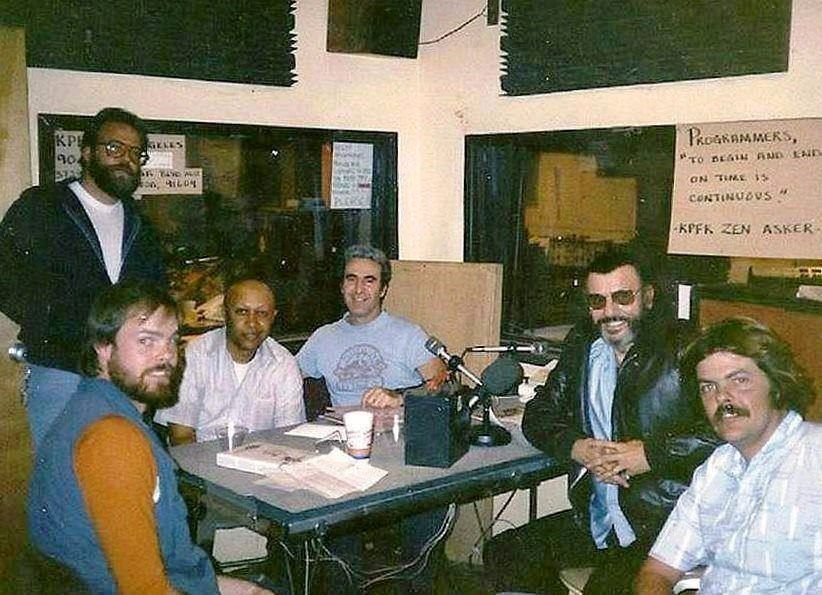
Folio: The Full Text of a KPFK Folio/program guide from 1979, & one from 1983

Standard

1979 I think these were scanned from a marginal-quality hard copy:

https://www.archive.org/stream/julyfolio1979kpfkrich/julyfolio1979kpfkrich_djvu.txt

http://www.archive.org/stream/janufolio83kpfkrich/janufolio83kpfkrich_djvu.txt

1985: Roy Tuckman, Anita Styles, Roberto Naduris, Jenny Hubbard, Don Rush, Pam Burton, John engineering, Corey Dubin-

kpfk85stafffolio (2)

Article: KPFK more History

Standard

KPFK more History

1949 KPFA/Pacifica goes on the air April 15

1959 KPFK goes on the air.  Lectures & classical music are the mainstay of the programming, Terry Drinkwater is the first manager.

1961 KPFK moves to North Hollywood.

1961 KPFK wins George Foster Peabody Award for excellence in broadcasting

1962 KPFK broadcasts women’s history profiles of Dorothy Healey and Elizabeth Gurley Flynn–programs that are later used in SISS Hearings charging Pacifica is communist infiltrated.

1962 The FCC withholds the license renewals of KPFA, KPFB, and KPFK pending its investigation into “communist affiliations.” Pacifica was never ultimately cited in any of these or subsequent inquiries. Ironically, the FCC chair later denounces the broadcasting industry for not defending Pacifica during its investigation of the foundation.

1963 The senate intelligence Subcommittee investigates whether station management are pacifist or communist

1964 The Federal Communications Commission (FCC) renews the licenses of all three Pacifica stations after a three-year delay.

1965 KPFK wins awards for its coverage of the Watts ‘riots’.

1970 KPFT in Houston goes on the air and is bombed off twice during its first year by Ku Klux Klan attacks on its transmitter tower. After months of inactivity by federal agents and Houston police, Pacifica mounts a media campaign. Federal agents ultimately arrest a Klansman and charge him with plotting to blow up KPFA and KPFK, as well as the actual KPFT bombing.

1970 The Pacifica stations (including KPFK) decline to join the new public radio service, National Public Radio.

1971 Noted folklorist Mario Casetta joins the station’s music staff, introducing World Music to the airwaves.

1971 KPFK builds its custom radio building.

1972 The Pacifica Radio Archive and Pacifica Program Service are established in Los Angeles to preserve and distribute Pacifica programming to schools, libraries, individuals, and other community radio stations across the country.

1974 The Symbionese Liberation Army delivers the Patty Hearst tapes to KPFA/Berkeley and KPFK/Los Angeles. In search of documents pertaining to domestic revolutionary groups, the LAPD searches KPFK for 8 ½ hours.  KPFK Manager Will Lewis is jailed for refusing to turn the tapes over to the FBI.

1975 KPFK’s transmitters go up on Mt. Wilson.

1980 Sharon Maeda becomes Executive Director of Pacifica, markets the sub-carrier frequencies, temporarily manages KPFK, and moves the Pacifica Radio Archives and the National Office into KPFK’s building in North Hollywood.

1984 With money troubles seeming insurmountable, the station goes off the air for 10 days late in September.

1986 After a broadcast of a play about AIDS, KPFK forces the FCC to adopt more narrowly defined rules regarding indecent speech.

1987 Lady Smith Black Mambazo makes their first live U.S. radio appearance, on KPFK/Los Angeles.

1989 KPFK creates its apprenticeship program to train women and people of color in radio production skills.

1992 Senate Republicans put a hold on funding for the Corporation for Public Broadcasting, claiming “liberal bias” on a host of issues, including environmental coverage. A bill is passed imposing “objectivity and balance” conditions on CPB funding. Almost alone among broadcasters, Pacifica protests any content-conditional funding, pressing CPB to shield all news programming and editorial integrity of individual producers–which CPB agrees to in its implementation protocols. Pacifica observes that no other broadcasters, commercial or religious, are any longer subject to access and balance requirements of the now-repealed Fairness Doctrine–making public broadcasters alone subject to editorial restrictions. Immediately after passage of the content restrictions, CPB Board member Victor Gold targets KPFK for strident African American programming and controversial speech aired during Black History month, by filing an FCC complaint.

1993 CPB Board member Victor Gold calls for de-funding Pacifica, echoing lobbying campaign orchestrated by right-wing media critics. In a unanimous vote, CPB reaffirms Pacifica’s funding irrespective of program content. Senate Minority Leader Robert Dole (R-KS) threatens public broadcasting with Congressional revenge, his aide explaining: “The First Amendment, freedom of speech, doesn’t apply, because we are able to put conditions on the grants of federal money. The same as we do for farmers.” Pacifica launches a campaign for unconditional funding and self-defense, led by a tremendous outpouring of “fightback donations” from listeners nationwide. CPB funding narrowly escapes cuts in the House of Representatives, with program content the driving issue. A lobbying effort keeps Pacifica funding off the Senate agenda. This is the second year in which Pacifica has received no discretionary funding from CPB (only the matching funding based upon listener contributions).

1993 Pacifica wins its third Court of Appeals ruling in six years, overturning the FCC restrictions on “indecent” programming as unconstitutional restrictions of the First Amendment rights of the radio audience.

1996 Former California Governor and future mayor of Oakland Jerry Brown hosts “We the People” on KPFK, & KPFA, a daily talk show that features interviews with Noam Chomsky, Paolo Soleri, Ivan Illich, and Gore Vidal.

1998 KPFK puts its Santa Barbara translator into operation.

2001 On December 12th the Pacifica board and dissident groups sign a settlement that leads to the democratization of the Pacifica radio network.  The listener-subscribers win the right to vote for representatives on their local station board.

When KPFK began broadcasting on July 26, 1959, it was the only public radio station in Los Angeles and the second public station in the country.  Notable Angelenos sat on the advisory board including Aldous Huxley, James Mason and Vincent Price, and architect Richard Neutra.  On April 27, Los Angeles commemorates Neutra Earth Day. Just like worldwide Earth Day (observed on April 22), Neutra Earth Day emphasizes sustainability and green lifestyles. But like most things in Los Angeles, it’s done with a Modern twist: it celebrates Neutra as a pioneer of the environmental movement.

The station was dedicated to bringing diverse voices together and thereby helping to forge a peaceful world.  From the station’s earliest days, KPFK invited opposing points of view on the air.  Communist Party organizer Dorothy Healy provided regular political commentaries, as did conservative activist Howard Jarvis.  KPFK was an open door for debate.

Because of its courageous championing of First Amendment freedoms, controversy dogged the station.  In 1964, the FBI asked the Attorney General to investigate KPFK broadcasts of the award-winning play, Who’s Afraid of Virginia Woolf? and a program in which two lesbians discussed their lives.  Seven years later, the FCC investigated the station because of a broadcast about a local college professor who had been fired after discussing a sexually explicit poem about Jesus in class.

KPFK also became the recipient of numerous messages from revolutionary groups active in the 1970s.  The LAPD spent 8 ½ hours rifling through station documents in pursuit of confidential materials received from the Weather Underground and the Symbionese Liberation Army.  Station manager Will Lewis went to jail twice for refusing to turn over those documents,

In the 1980s, KPFK went to the Supreme Court to protect the right of all public radio stations to editorialize.  Later in the decade, the station defended its broadcast of a sexually explicit play about a man dying of specific criteria for judging indecent speech on the airwaves.

Over the years, KPFK has won some of journalism’s most coveted awards including dozens of “Golden Mikes”, a George Foster Peabody Award and an Alfred I. Dupont Award.

2015-04-06 36 paid employees

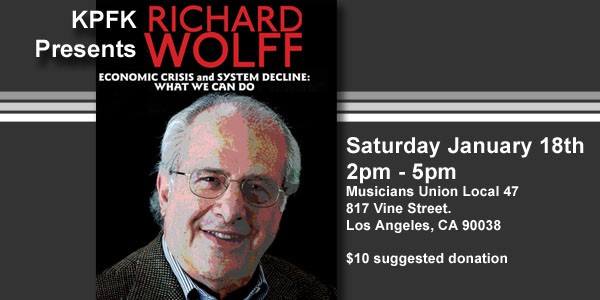
WBAI & KPFK’s economist Richard Wolff also had an event

Standard

“Capitalists in the 1970s realized they no longer needed to pay high wages to American, European and Japanese workers, when they could simply relocate their centers to countries with no wage regulations” -Professor and Economist Richard Wolf

 Richard Wolf discusses the history of capitalist resistance from Germany to Greece for KPFK audience members. http://ow.ly/i/8BWOj

kpfkrichardwolff2
Paraphrase of R. Wolff: We had serfs controlled by their feudal land/lords.
We had slaves controlled by their “owners”.
Now we have wage slaves controlled by their employers, who can fire them without cause any time, see ‘At Will Labor force’.

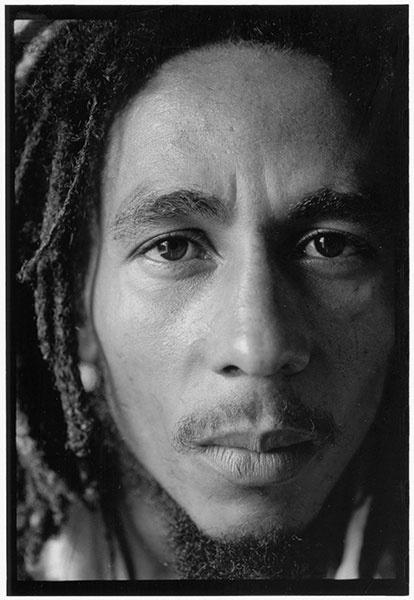
Audio: KPFK has Bob Marley day, born Feb. 22, 12 hours, 2015

Standard

chrome-extension://nlbjncdgjeocebhnmkbbbdekmmmcbfjd/subscribe.html?http%3A%2F%2Farchive.kpfk.org%2Fparchive%2Fxml%2Fspecial.xml

Ziggy Marley pops by the KPFK Studios to have a chat with Reggae Central host Chuck Foster and join the celebration of “Marley Day on KPFK” We’re going all the way till Midnight, please show your support by calling (818) 985-5735  at KPFK 90.7 FM Los Angeles / 98.7 FM Santa Barbara.kpfkziggy

KPFK’s Jee co-produces Bach in the Subways in Los Angeles March 21

Standard

http://www.latimes.com/entertainment/arts/la-et-cm-bach-subways-20150320-story.html

kpfklabach

It’s also in places all over the world.

http://bachinthesubways.com/

Enlightenment Music Series, a chamber music group that usually performs in Pasadena, will play the Brandenburg Concerto No. 4 near Traxx restaurant in Union Station. It’s a number that Jeehyun Lee, the 34-year-old organizer of L.A.’s Bach in the Subways performances, refers to as her “childhood jam.”

Lee works for the North Hollywood-based radio station KPFK, and although she doesn’t play music herself she is deeply in love with classical music and the work of Bach in particular. She contacted Henderson last year after a friend told her about the Bach event.

“The beauty of the project is so simple and so pure,” Lee says. “We just want to play music for you, and we don’t expect anything in return — a rarity in our society. That’s just so moving.”

The role of L.A. organizer didn’t previously exist, so she created it. That’s how the volunteer program operates, says Henderson, who calls the structure “anarchical.”

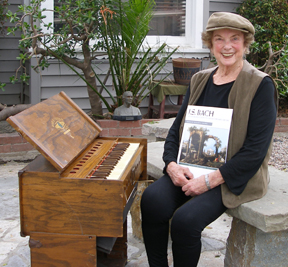
KPFK’s Uncle Ruthie performs In Bach in the Subways March 21

Standard

http://bachinthesubways.com/events/uncle-ruthie-buell-5-hr-marathon-with-her-100-yr-old-pump-organ-chevaliers-bookstore/

OLYMPUS DIGITAL CAMERA

Chevalier’s Bookstore, 126 N Larchmont Blvd, Los Angeles

UNCLE RUTHIE will be performing in front of Chevalier’s Bookstore with her 100 year old pump organ!

Ruthie “Uncle Ruthie” Buell is a poet, a songwriter, a music teacher and has been a radio broadcaster on KPFK 90.7 FM for over 50 years.  She’s the host of the children’s show “Halfway Down the Stairs” on KPFK. From both Chicago and a farm in Wisconsin, Ruthie has been the creator of art and song and artistic experiences for as long as anyone has known her. She often performs at Beyond Baroque and the Workman’s Circle in the Pico-Robertson neighborhood, makes delicious meals for friends and neighbors with lots of butter and cream, and can play every instrument hanging on a wall or placed on a tabletop of her home. Her most recent inspired projects have been a book of poems and the creation of The Poet Tree, her front yard Chinese Elm that invites passersby to sit under its shade, write a verse and pin it to the tree.

KPFK’s Mark Kline passed

Standard

We at KPFK are saddened to learn of the passing of our dear friend, Mark Klein, a great and long-time supporter of the station. Mark was admired and loved for his wit and encyclopedic knowledge of culture and the Rock and Roll era in particular. His was a presence we could count on during each of our many fund drives. Mark dealt with his illness with courage and grace. We will miss him a lot. by Allan Coie

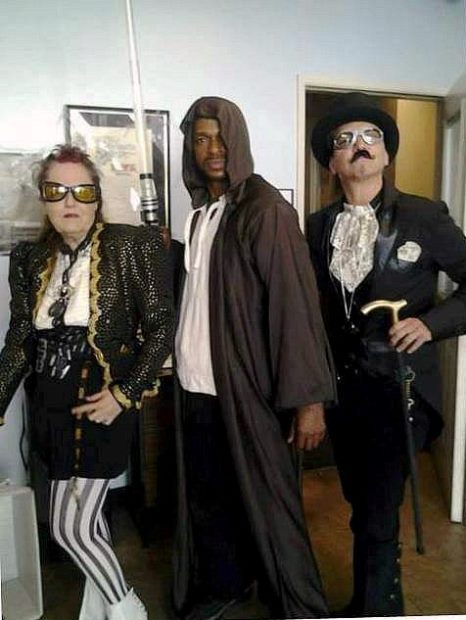
Sad News, Long time supporter and volunteer at KPFK for many years, Mark Kline has passed. His devotion and love for the station was incredible. His creative costumes always brightened up the phone room. It was always great to see his smiling face out around town at music and other events. R.I.P. Mark you will be sorely missed! heart emoticon
A gathering celebrating Mark and his life takes place this Sunday March 22 2-5pm in Burbank. Inbox us if you’d like to attend.

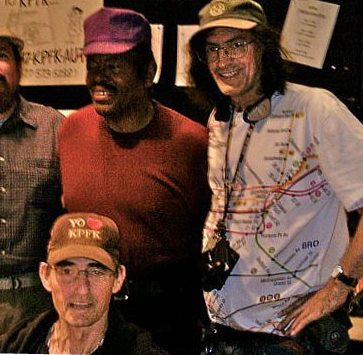
kpfkMarkKleinhalfDJ

That’s Mark, seated.

KPFK’s host Wanda Coleman, & unofficial poet laureate of Los Angeles

Standard

wandacoleman

She received fellowships from the John Simon Guggenheim Foundation, The NEA, and the California Arts Council (in fiction and in poetry). She was the first C.O.L.A. literary fellow (Los Angeles Department of Cultural Affairs, 2003). Her honors included an Emmy in Daytime Drama writing, The 1999 Lenore Marshall Prize (for “Bathwater Wine”), and a nomination for the 2001 National Book Awards (for “Mercurochrome”). She was a finalist for California poet laureate (2005).[citation needed]  

She was married to co-host poet Austin Strauss.  She passed in 2013.

KPFK: Tavis Smiley on Jon Wiener’s show, & with IGM Zuberi Fields

Standard

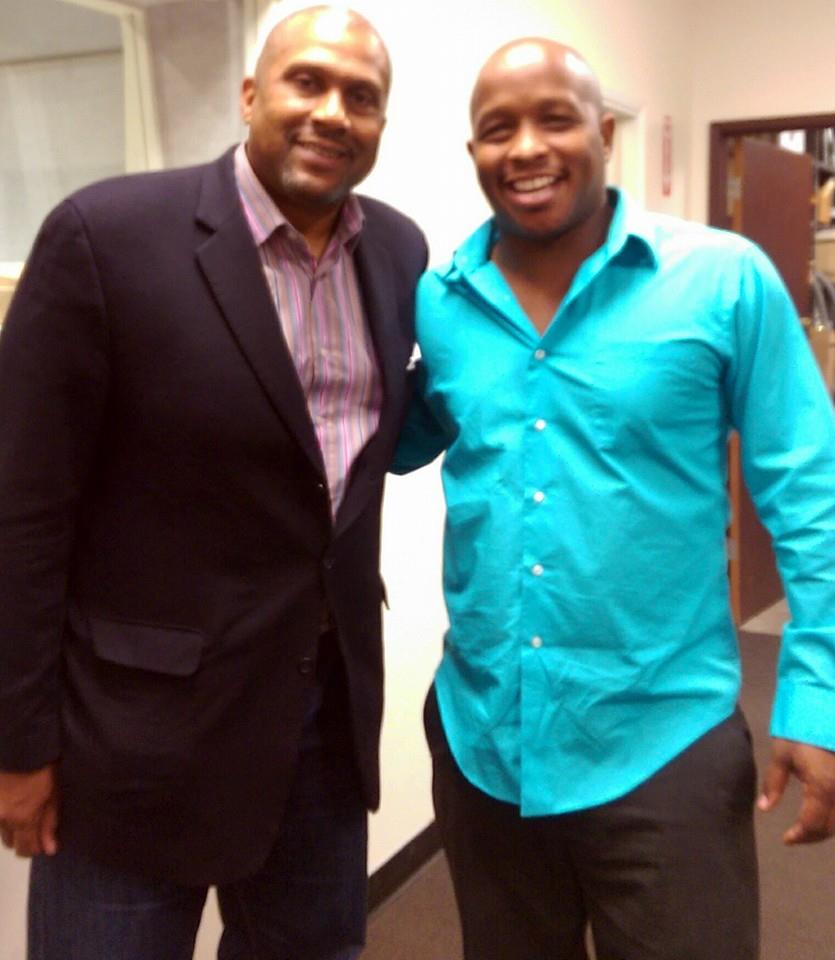
Tavis Smiley will be on KPFK today on The 4 O’clock Report with Jon Wiener to talk about his book “Death of a King: The Real Story of Dr. Martin Luther King Jr.’s Final Year.”
You can read an except of the book here via Democracy Now:http://www.democracynow.org/…/2014/9/10/read_death_of_a_kin…

Watch Tavis Smiley on Democracy Now! Thursday, and read the introduction and first chapter of his new book, which examines the personal struggles of Martin…
DEMOCRACYNOW.ORG

kpfktavis&zu

Robert & Josh Scheer, now of Truthdig

Standard

kpfkscheers

Robert Scheer, editor in chief of Truthdig, has built a reputation for strong social and political writing over his 30 years as a journalist. His columns appear in newspapers across the country, and his in-depth interviews have made headlines. He conducted the famous Playboy magazine interview in which Jimmy Carter confessed to the lust in his heart and he went on to do many interviews for the Los Angeles Times with Richard Nixon, Ronald Reagan, Bill Clinton and many other prominent political and cultural figures.

Between 1964 and 1969 he was Vietnam correspondent, managing editor and editor in chief of Ramparts magazine. From 1976 to 1993 he served as a national correspondent for the Los Angeles Times, writing on diverse topics such as the Soviet Union, arms control, national politics and the military. In 1993 he launched a nationally syndicated column based at the Los Angeles Times, where he was named a contributing editor.  That column ran weekly for the next 12 years and is now based at Truthdig.

He is currently a clinical professor of communications at the University of Southern California’s Annenberg School for Communication and Journalism. Scheer has written nine books, including“Thinking Tuna Fish, Talking Death: Essays on the Pornography of Power”; “With Enough Shovels: Reagan, Bush and Nuclear War”; “America After Nixon: The Age of Multinationals”; with his son Christopher and Lakshmi Chaudhry, “The Five Biggest Lies Bush Told Us about Iraq”; “Playing President: “My Close Encounters with Nixon, Carter, Bush I and Clinton—and How They Did Not Prepare Me for George W. Bush”; and “The Pornography of Power: How Defense Hawks Hijacked 9/11 and Weakened America.”Scheer’s latest book, “The Great American Stickup: How Reagan Republicans and Clinton Democrats Enriched Wall Street While Mugging Main Street” (Nation Books), was released on September 7, 2010.  http://www.truthdig.com/